Skip to content
Skunk Removal Services
Proudly serving: Hamilton, Burlington, Oakville, Kitchener, Waterloo, Guelph & Niagara
Skunks are widespread across Ontario and are well adapted to residential neighbourhoods where food and sheltered spaces are readily available. They often choose quiet, protected spaces around homes for shelter, making areas beneath decks, sheds, porches, and additions especially attractive denning locations.
Professional skunk removal focuses on determining where the animals are living and resolving the conditions that allow them to stay there. Acting early can help prevent persistent odours, lawn damage, encounters with pets, and the possibility of a skunk establishing a longer-term den.
Our licensed wildlife technicians assess the property for active dens, access points, and signs of skunk activity before recommending an appropriate removal plan. We rely on humane exclusion as our main approach, allowing the skunk to leave before vulnerable openings are secured with wildlife-resistant materials to help keep animals from moving back underneath the structure.
Signs of Skunk Activity
- Strong, lingering skunk odours around the property.
- Holes or openings beneath decks, sheds, and porches that may be used as den entrances.
- Damaged lattice or displaced barriers around decks, sheds, or porches.
- Regular nighttime sightings of skunks travelling through the property.
A skunk taking shelter around your property can create problems that extend well beyond its unmistakable smell. When startled by people, pets, or nearby activity, a skunk may spray, leaving an odour that can linger around decks, sheds, yards, and even enter the home.
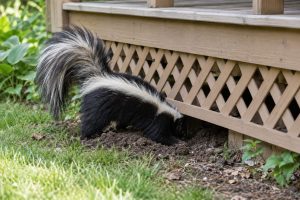
Skunks are also active foragers and may leave small holes throughout lawns and gardens while searching for grubs and other insects.
Sheltered spaces beneath porches, decks, and sheds can become established den sites, especially during Ontario’s breeding and baby season. Once a skunk becomes comfortable using these areas, activity may continue unless the den and access point are properly addressed.
Professional skunk removal focuses on safely resolving the current activity while using humane exclusion methods to help prevent the same space from becoming an easy shelter again.
What can you expect from our Skunk Removal services?
Removing a skunk from beneath a deck, shed, or porch requires a solution that deals with both the animal and the space it has been using. Our experienced, licensed wildlife removal technicians begin by locating the active den and determining the most appropriate humane removal approach.
We specialize in exclusion work using one-way doors, which gives skunks a way to leave while restricting their ability to get back underneath the structure. After the animals have safely moved out, the access area can be reinforced and sealed with durable wildlife-resistant materials to discourage future denning.
By combining humane removal with proper exclusion, we address the source of the problem rather than simply relocating the animal. Sealed areas are backed by a warranty, providing added protection for the work completed around your property.
Our skunk removal services include:
- Exterior inspection
- Entry point screening and sealing
- Humane removal options
- 5 year warranty
Why Choose us for Skunk Removal?
A lasting solution to a skunk problem starts with understanding why the animal has chosen your property for shelter.
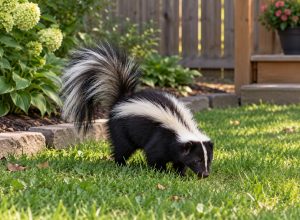
Our licensed wildlife technicians have experience identifying active dens and access points around decks, sheds, porches, and other common problem areas on Ontario properties. Rather than simply removing the animal and leaving the space accessible, we prioritize humane exclusion and properly securing vulnerable areas with wildlife-resistant materials.
We can also identify conditions around the property that may be encouraging skunk activity, giving you practical advice to help reduce the chance of another skunk taking over the same den.
- Humane Removal Methods
- Licensed and Insured Technicians
- 100% Customer Satisfaction
- Reliable and Long Lasting Results
Get A Free Estimate
Wildlife Services:
Pest Services:
Frequently Asked Questions:
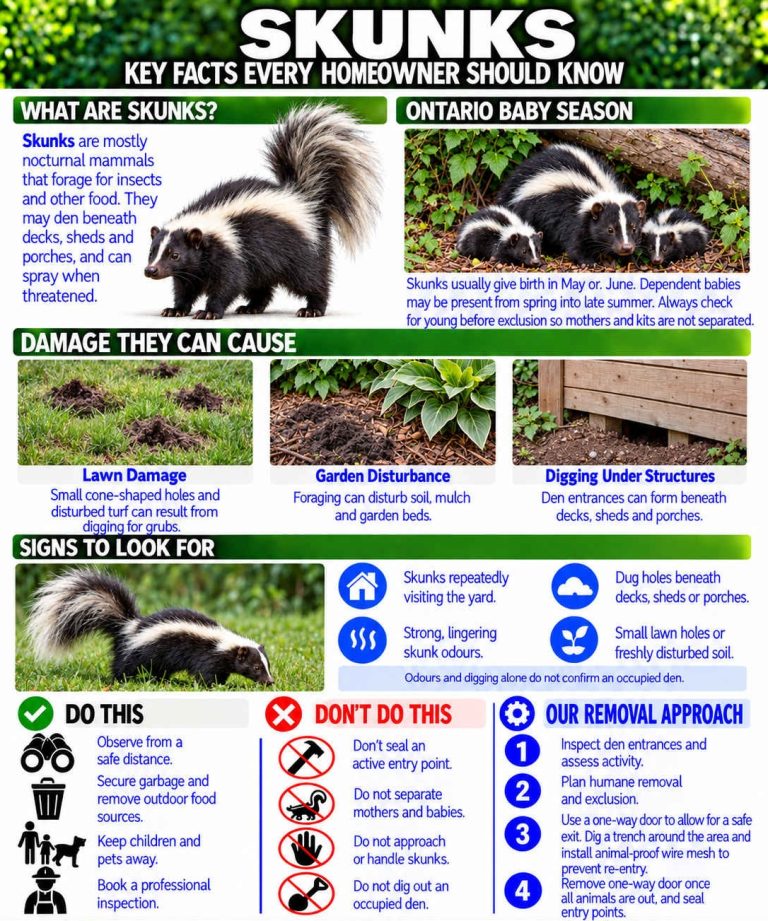
Common signs include repeated skunk sightings around the same area, a strong lingering odour, disturbed soil, and holes dug beneath decks, sheds, porches, or other structures. You may also notice tracks or a well-used path leading to an opening.
Professional skunk removal starts with determining where the animal is living and how it is accessing the area. Skunks commonly den beneath decks, sheds, porches, additions, and other low structures. Our preferred approach is humane exclusion, which allows the skunk to leave before the area is secured to help prevent it from getting back underneath.
A one-way door is a wildlife exclusion device installed over an active entry point. It is designed so an animal can push through the device to exit but cannot easily travel back through it to re-enter the structure. Once activity has stopped and the skunks are confirmed to be out, the device can be removed and the opening sealed.
Yes, our sealed areas are backed by a 5 year warranty according to the terms of the completed work. The warranty applies to the areas we have professionally secured, rather than guaranteeing that wildlife cannot access an unrelated or untreated portion of the building.
If baby skunks are present during the removal process, the technician will take additional care to avoid separating them from their mother. When appropriate, the technician can create a small opening that allows the babies to safely exit the den and reunite with their mother outside. Once the skunk family has moved on and the den is confirmed to be empty, the area can be properly secured to help prevent future wildlife activity.
Depending on the structure and surrounding ground, exclusion may involve digging a trench and installing animal-proof wire mesh around the vulnerable perimeter. The mesh creates a physical barrier that helps prevent skunks from digging underneath the structure again. The exact approach depends on the property and accessibility around the denning area.
A skunk may eventually move between den sites, but there is no reliable timeline for when that will happen. If a property provides shelter and nearby food sources, the animal may continue using the area. Even if it leaves temporarily, an accessible opening can allow the same skunk or another animal to return.
Yes, skunk trapping is available in certain situations, but it is generally considered an alternative when exclusion is not appropriate or practical. Our technicians can assess the property and determine whether exclusion or trapping is better suited to the situation.
Trapping depends on the behaviour of a wild animal, so there is no way to guarantee that a specific skunk will enter a trap. Weather, food availability, movement patterns, nearby den sites, and other animals can all influence whether a trap is approached. There is also a possibility of capturing a non-target animal. For these reasons, trapping cannot carry the same certainty as physically excluding access to a known denning area.